
Oct 01, 2025
Dengue, Malaria & Typhoid: Key Diagnostic Differences You Must Know
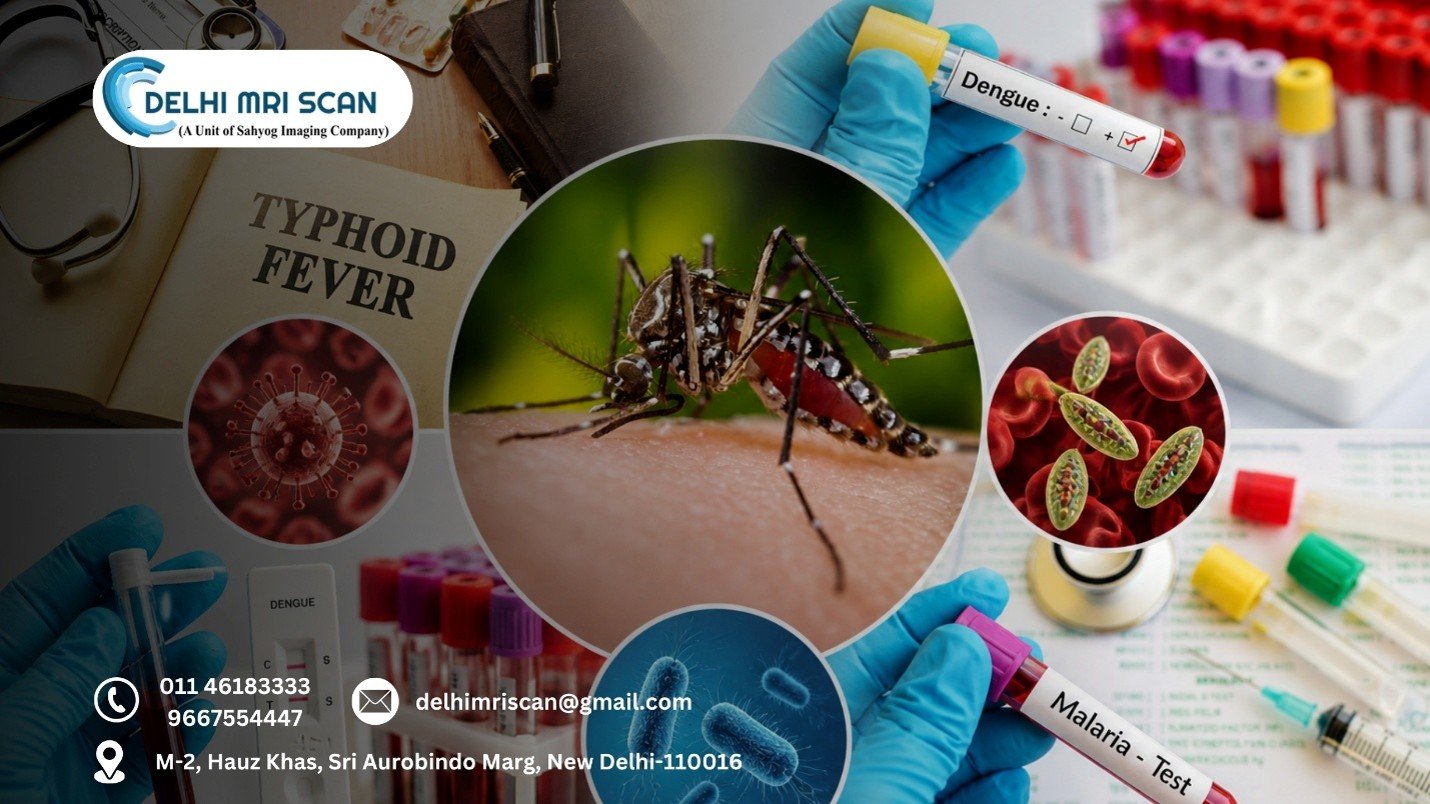
Every monsoon season, hospitals across India see a surge of patients with high fever, body aches, and fatigue. Three culprits dominate the diagnosis charts: Dengue, Malaria, and Typhoid. While they share similar early symptoms, their treatments differ dramatically—and a wrong diagnosis can be dangerous.
Understanding the key diagnostic differences between these diseases can save precious time and lives. If you're searching for reliable diagnostic centre in South Delhi, this guide will help you know exactly what to ask for when you visit a diagnostic centre.
Why These Three Diseases Get Confused
All three illnesses are common in tropical regions like India and often begin with:
- High fever
- Headache
- Body pain
- Nausea
However, they're caused by entirely different organisms and require different treatments:
- Dengue: Caused by a virus (Flavivirus)
- Malaria: Caused by a parasite (Plasmodium)
- Typhoid: Caused by bacteria (Salmonella Typhi)
The overlapping symptoms make accurate diagnostic testing essential rather than guessing based on symptoms alone.
Key Differences in Symptoms: A Quick Reference
Before diving into tests, let's understand how symptoms differ:
Table
|
Symptom |
Dengue |
Malaria |
Typhoid |
|
Fever Pattern |
Sudden high-grade (up to 104°F) |
Cyclical with chills & sweats |
Gradual, step-ladder pattern |
|
Headache |
Intense, behind eyes |
Moderate to severe |
Mild to moderate |
|
Muscle & Joint Pain |
Severe ("breakbone") |
Milder |
Mild or absent |
|
Rash |
Appears 2-5 days after fever |
Rare |
Sometimes (rose spots) |
|
Abdominal Pain |
Mild |
Mild to moderate |
Persistent & common |
|
Chills |
Rare |
Classic symptom |
Rare |
|
Bleeding |
Possible (gums/nose) |
Rare |
Rare |
|
Constipation/Diarrhea |
Rare |
Rare |
Common |
While these patterns help doctors suspect a particular disease, only laboratory diagnostic tests can confirm which infection you have.
Diagnostic Tests for Dengue: What Makes It Unique?
Dengue testing focuses on detecting the virus or your immune response to it.
1. NS1 Antigen Test
- What it detects: The NS1 protein from the dengue virus itself
- Best timing: First 0-5 days of fever (acute phase)
- Sample: Blood test
- Key advantage: Can detect dengue before antibodies develop
- Result time: Same day
2. IgM and IgG Antibody Tests
- What it detects: Your body's immune response
- IgM: Appears after 3-5 days, indicates recent infection
- IgG: Appears after 7 days, indicates past or secondary infection
- Important note: In secondary dengue infections, IgM may be low or undetectable while IgG is already high
- Sample: Blood test
- Result time: Same day to 24 hours
3. Platelet Count & Hematocrit
- Platelet count: Often low in dengue (thrombocytopenia)
- Hematocrit (Hct): Often highdue to plasma leakage
- A rise >20% from baseline is a warning sign for severe dengue
- Sample: CBC (Complete Blood Count)
- Result time: Same day
4. Molecular Tests (RT-PCR)
- What it detects: Viral RNA
- Best for: Early diagnosis, serotype identification
- Advantage: Most specific test available
- Limitation: Not always available in all labs
Diagnostic Tests for Malaria: The Gold Standard
Malaria diagnosis is unique because it involves directly visualizing the parasite.
1. Blood Smear Microscopy (Thick & Thin Films)
- The gold standard test for malaria diagnosis
- Thick smear: Detects presence of parasites (more sensitive)
- Thin smear: Identifies species (P. falciparum, P. vivax, etc.) and counts parasitemia
- Process: Blood sample is stained and examined under a microscope
- Key point: If the first smear is negative but malaria is suspected, repeat every 12-24 hours for three sets before ruling out malaria
- Sample: Blood collected by finger prick or venous draw
- Result time: 2-4 hours
2. Rapid Diagnostic Tests (RDTs)
- Detects: Malaria antigens (proteins) in blood
- Advantage: Results in 15-20 minutes
- Limitations:
- Cannot identify species reliably
- Cannot quantify parasitemia
- Should always be confirmed with microscopy
- Best for: Remote areas, emergency departments
3. PCR (Polymerase Chain Reaction)
- Useful for: Species confirmation when microscopy is unclear
- More sensitive than microscopy in some cases
- Limitation: Results may take days, not useful for immediate treatment decisions
4. Hematological Clues
- Hemoglobin (Hb): Often low due to RBC destruction by parasites
- RBC count: Decreased
- Liver enzymes: May be elevated
Diagnostic Tests for Typhoid: Detecting the Bacteria
Typhoid diagnosis relies on detecting antibodies or the bacteria themselves.
1. Blood Culture
- The most reliable test, especially in early stages
- What it detects: Live Salmonella Typhi bacteria growing in culture
- Sample: Blood
- Sensitivity: 40-80% depending on timing and technique
- Limitation: Takes 2-5 days for results
- Key advantage: Can test antibiotic susceptibility
2. Widal Test
- Detects: Antibodies against Salmonella antigens (O and H)
- Interpretation:
- Single high titer (≥1:160 for O antigen) suggests infection
- Four-fold rise in paired samples confirms diagnosis
- Limitations:
- Can be positive in vaccinated individuals
- May be negative in early disease
- Cross-reactions possible
- Result time: Same day
3. Typhidot/IgM Test
- Detects: Specific IgM antibodies against Salmonella
- Advantage: Earlier detection than Widal
- Result time: Same day to 24 hours
4. Complete Blood Count (CBC)
- WBC count: Often low (leukopenia)
- Platelets: May be low
- Hemoglobin: May be normal or low
Prevention Tips to Stay Safe
Dengue Prevention
- Eliminate mosquito breeding sites (standing water)
- Use mosquito repellents (DEET, picaridin)
- Wear long-sleeved clothing
- Install window screens
- Avoid outdoor activities at dawn/dusk when Aedes mosquitoes bite
Malaria Prevention
- Use insecticide-treated bed nets
- Take prophylactic medication if traveling to endemic areas
- Wear protective clothing
- Use mosquito repellent
Typhoid Prevention
- Get vaccinated (especially before travel)
- Drink only purified/boiled water
- Eat properly cooked food
- Practice thorough hand hygiene
- Avoid street food in areas with poor sanitation
Overall Summary
Dengue, malaria, and typhoid may start similarly, but their treatments are completely different. Taking antimalarial drugs for dengue won't help. Using antibiotics for malaria is ineffective. Only accurate diagnostic tests can guide proper treatment.
If you're experiencing persistent fever in South Delhi, don't wait. Visit Delhi MRI Scan, a trusted diagnostic centre in South Delhi, for a comprehensive fever panel. With same-day reporting available at facilities like Delhi MRI Scan, you can get answers quickly and start the proper treatment immediately.
Related post

Dec 15, 2025
Tests Every Woman Should Consider After 30
Dec 02, 2025
