

Aug 03, 2026
Why Children Need Diagnostic Care Too, A Parent's Guide
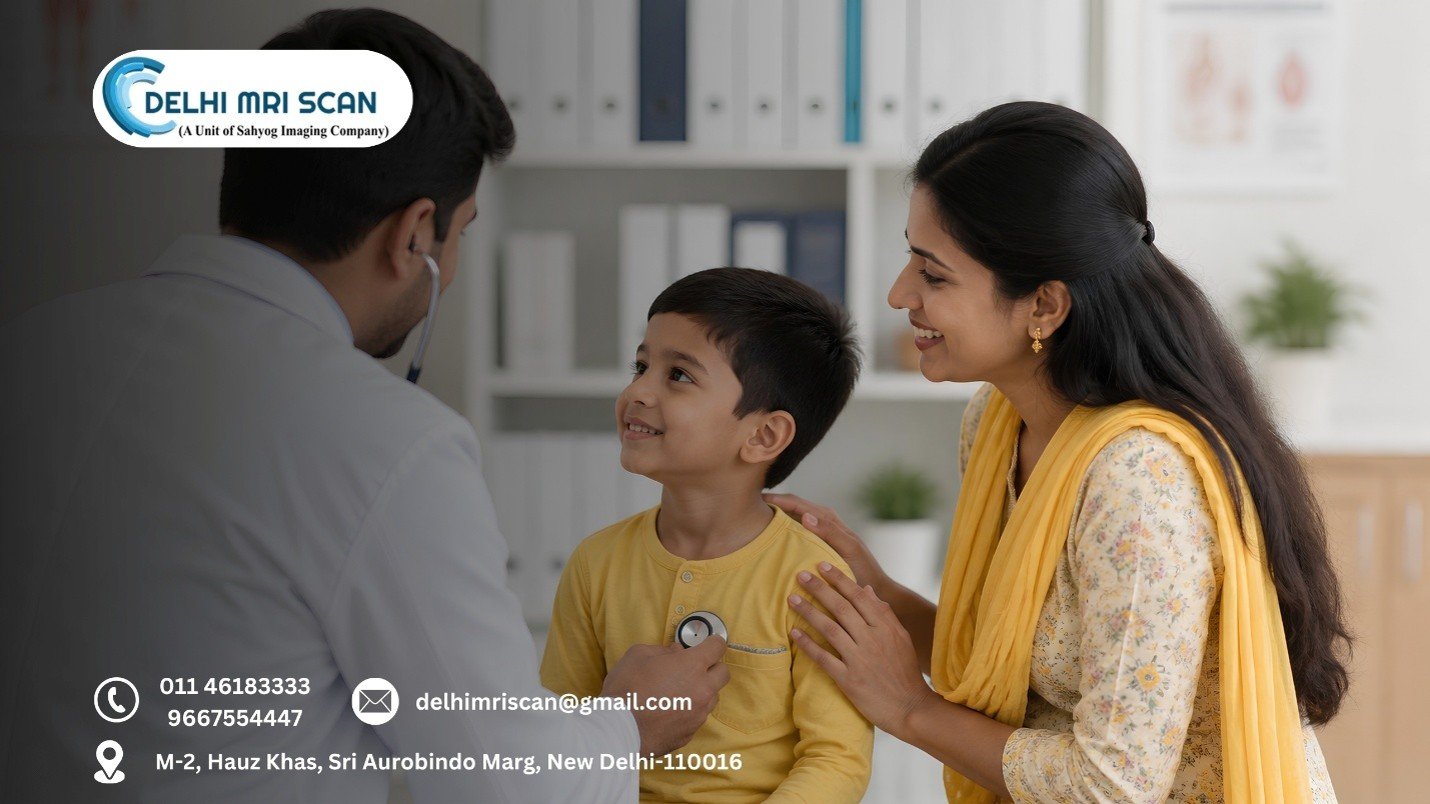
Most parents think of medical tests as something adults need. Not children. After all, children are young, active, and full of life. How serious could it really be?
The truth is, children fall sick too. They get injured, they develop infections, they experience pain they cannot always put into words, and sometimes their bodies go through changes that need a doctor's attention. The difference is that children, especially young ones, cannot tell you exactly what is wrong. They cannot describe where it hurts, how long it has been hurting, or what makes it feel worse.
That gap between what a child feels and what a parent or doctor can see is exactly where diagnostic care steps in.
At Delhi MRI Scan, one of Delhi's most trusted diagnostic centres, we work with children of all ages, from infants to teenagers. And the one thing we see repeatedly is this: when parents act on their instincts early and get the right tests done at the right time, outcomes are almost always better. This guide is written to help you understand when your child may need diagnostic evaluation, what kinds of tests are available, and why early detection genuinely matters.
What Is Diagnostic Care and Why Do Children Need It?
Diagnostic care is simply the process of finding out what is causing a child's symptoms. It begins with a doctor's examination and medical history, and when more information is needed, the doctor may recommend specific tests, blood tests, urine tests, ultrasound, X-ray, MRI, CT scan, or other procedures depending on what needs to be evaluated.
The goal is not to run every possible test on every child. The goal is to use the right test at the right time, the one that will give the doctor the most useful information about what is actually happening inside your child's body.
Children are not small adults. Their bodies are still growing. Their symptoms can present differently. And certain health conditions, if not identified early, can affect their growth, development, learning, and long-term wellbeing. This is why diagnostic care for children is just as important as it is for adults, and in some cases even more so.
Common Reasons Children Need Diagnostic Tests
Children can need medical testing for a wide variety of reasons. Some are related to injuries from everyday physical activity. Others are related to infections, digestive problems, or neurological symptoms. Some may involve concerns about development, growth, or unusual physical changes.
Here are the most common situations where a doctor may recommend diagnostic testing for a child.
- Persistent or recurring headaches are more common in children than many parents realise. Most headaches in children have simple causes, dehydration, stress, poor sleep, or vision problems. But headaches that keep coming back, that are unusually severe, or that come with vomiting, vision changes, weakness, or balance problems need proper medical evaluation. A doctor will decide whether imaging is needed based on the full picture of symptoms.
- Unexplained abdominal pain is one of the most frequent reasons parents bring children in for evaluation. Stomach aches in children are common and usually not serious. But when abdominal pain is persistent, severe, or comes with fever, vomiting, weight loss, or changes in toilet habits, it needs to be investigated properly. Ultrasound is one of the most useful tools for evaluating the abdomen in children because it does not use radiation and provides clear images of internal organs.
- Bone and joint pain after injuries are another very common reason for diagnostic testing in children. Children fall. They run into things. They play hard. Sometimes the result is a fracture or joint injury that is not immediately obvious from the outside. A child may keep complaining of pain even when there is no visible swelling or bruising. An X-ray can help assess bones, and in certain situations, MRI may be needed to evaluate soft tissues, joints, or other structures that X-rays cannot clearly show.
- Breathing difficulties and persistent cough, when a child is consistently struggling with breathing, wheezing, or a cough that does not clear up, further investigation may be needed. A doctor may recommend a chest X-ray or other tests to look for underlying causes.
- Seizures or unusual episodes in a child always require prompt medical evaluation. Whether it is a first seizure or a recurring one, a neurologist needs to be involved, and imaging of the brain may be recommended to look for any structural cause.
- Frequent infections, some children seem to fall sick again and again, far more often than other children their age. When this pattern is persistent, it may be a sign that something needs to be investigated, whether related to the immune system, anatomy, or another underlying cause.
- Developmental delays or neurological concerns, if a child is not reaching expected milestones for their age, or if parents notice changes in their child's movement, coordination, speech, or behaviour, a thorough medical and neurological evaluation is important. In some cases, brain or spinal cord imaging may be part of that assessment.
- Unexplained lumps or swellings anywhere on the body in a child should always be checked by a doctor. Most will turn out to be harmless, swollen lymph nodes from a minor infection are very common in children. But a lump that grows, persists, or is associated with other symptoms like fever or weight loss needs proper evaluation.
- Unexplained weight loss, persistent fatigue, or ongoing fever without a clear cause are symptoms that should never be ignored in a child. These are the kinds of symptoms that deserve a thorough workup, including blood tests and possibly imaging, to find out what is going on.
Understanding the Types of Diagnostic Tests for Children
Knowing what different tests do can help parents feel less anxious when a doctor recommends one.
- Blood Tests are among the most commonly performed diagnostic tests for children. They can check for infections, anaemia, inflammation, kidney and liver function, hormone levels, and many other important health parameters. A blood test is usually quick and provides a great deal of useful information.
- Urine Tests are simple, non-invasive, and very useful for detecting urinary tract infections, kidney problems, and certain metabolic conditions in children.
- Ultrasound is one of the safest and most widely used imaging tests for children. It uses sound waves, not radiation, to create images of organs and soft tissues. It is commonly used to evaluate the abdomen, kidneys, bladder, pelvis, and other structures. Children generally tolerate ultrasound well because it is painless and does not require them to stay very still for a long time.
- X-Ray uses a small amount of radiation to produce images of bones and certain soft tissue structures. It is most commonly used to evaluate fractures, chest conditions, and some digestive issues. At Delhi MRI Scan, appropriate protocols are followed to ensure the lowest necessary radiation dose is used for children.
- MRI (Magnetic Resonance Imaging) uses a powerful magnet and radio waves, no radiation, to produce highly detailed images of the brain, spinal cord, joints, and soft tissues. MRI is particularly valuable for evaluating neurological symptoms, joint injuries, and certain organ conditions in children. Because children need to stay very still during an MRI, younger children may sometimes require sedation, a decision made by the medical team based on the child's age and ability to cooperate.
- CT Scan (Computed Tomography) provides detailed cross-sectional images of the body and is a powerful diagnostic tool when used appropriately. Because CT scans involve more radiation than X-rays, they are recommended only when the medical need is clear and the information they provide cannot be obtained through other methods. Children's bodies are more sensitive to radiation than adults', which is why CT scans in children require careful consideration and appropriate dose protocols.
Signs That Should Never Be Ignored in a Child
As a parent, you are the first line of observation for your child's health. You notice things no doctor sees in a ten-minute consultation. Trust your instincts, and act on them when something does not seem right.
These are the signs that should always prompt a medical consultation without delay.
Any lump or swelling that persists for more than two weeks or continues to grow. Persistent headaches, especially those accompanied by vomiting or vision changes. A first-time seizure at any age. Ongoing unexplained fever that does not respond to normal treatment. Significant unexplained weight loss. Persistent abdominal pain, particularly with fever or digestive changes. Difficulty walking, loss of coordination, or any regression in physical abilities the child previously had. Unusual bleeding or bruising without a clear cause. A persistent cough or breathing difficulty that does not resolve. Any symptom that your gut tells you is not normal for your child.
None of these symptoms automatically means something serious is wrong. But each of them deserves a proper medical evaluation, not a wait-and-see approach that stretches into weeks or months.
The Role of Parents in Early Detection
Doctors see your child for a few minutes at a time. You see your child every day. That makes you one of the most important people in your child's healthcare journey.
Pay attention to changes, even subtle ones. A child who suddenly seems less energetic, who stops eating well, who becomes unusually irritable or withdrawn, who complains about the same pain again and again, or who is not growing or developing at the pace they should be, these are all things that deserve attention.
Keep a simple note of symptoms when they occur. Write down when the symptom started, how often it happens, what makes it better or worse, and whether it is getting worse over time. This kind of record is genuinely useful to a doctor trying to understand your child's situation.
And when a doctor recommends a test, ask them to explain what the test is for and what it is looking for. An informed parent is a better partner in their child's healthcare.
Overall Summary: Your Child's Health Deserves Timely Answers, Delhi MRI Scan
Children deserve the same quality of diagnostic attention that adults receive. Their symptoms are real. Their pain is real. And their health conditions, when they exist, are real too.
The goal of diagnostic care for children is not to alarm parents or to find problems where none exist. It is to get clear, accurate information when something is not right, so that doctors can make the best possible decisions about your child's care. It is to catch things early when catching them early makes a difference. And it is to give parents the answers they need instead of uncertainty that stretches on for months.
At Delhi MRI Scan, a trusted diagnostic centre in Delhi, we understand that bringing your child in for a test can feel stressful. Our team is experienced in working with children and is committed to making the experience as comfortable, clear, and reassuring as possible.
If your child has persistent symptoms that concern you, do not wait for things to improve on their own. Speak to your doctor. Get the right test done. And get the answers your child's health deserves.
Related post
Dec 15, 2025
Tests Every Woman Should Consider After 30

Dec 02, 2025
